
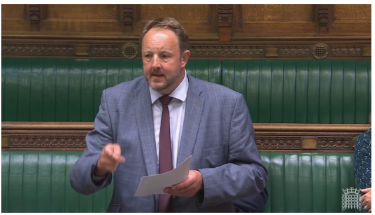
Toby Perkins, MP for Chesterfield, and Chair of the Environmental Audit Committee, spoke during the debate in Parliament today (24 June 2026) in support of the Seventh Carbon Budget.
The Seventh Carbon Budget sets the level of emissions reduction for the UK for 2038 to 2042, as compared to 1990 levels, on the pathway to balance the UK’s carbon emissions by 2050.
This was the level advised by the independent Climate Change Committee and recommended by the Environmental Audit Committee, at the conclusion of their inquiry into the Seventh Carbon Budget.
The text of Toby’s full speech is below:
Mr Speaker, I very much welcome the Carbon Budget Order which sets the level of the Seventh Carbon Budget, on the way to our long-term, and previously cross-party, aim to balance the UK’s carbon emissions by 2050.
The government is proposing today to set the level for the Seventh Carbon Budget at a target of 87% emissions reduction for the period 2038 to 2042, as compared to 1990 levels. This was the level advised by the independent Climate Change Committee and recommended by the Environmental Audit Committee, at the conclusion of our inquiry into Carbon Budget 7.
I also want to warmly welcome the fact that this debate is taking place at all.
The previous government approved CB6 in 17 minutes in a DL session in a committee room far away from public scrutiny. These are crucial matters and will have wide-ranging impacts on all of us whether these measures are adopted, or in the event they are not.
And for that reason, it is crucial that parliament gets to debate the path the government is setting out and enable others to make their alternative argument.
In debating this order, I have to say how disappointing it is that the political consensus that existed has evaporated. It lasted from the seminal introduction of the Climate Change Act in 2008 under Labour, was strengthened and updated in 2019 by the Conservative government.
In the introduction of the CCA and in the pathway to net zero, Britain was world-leading in our ambition, and the approach was so admired that it was copied by many other legislatures- how tragic that the opposition should choose to jettison one of their greatest achievements in the face of the threat from the climate deniers in Reform.
Because Mr Speaker, the approach pursued by successive is working- since 1990, the UK’s greenhouse gas emissions have been cut by 50%.
At the same time, the UK economy has grown, partly powered by the green economy, which last year was found to be growing at three times the rate of the rest of the economy, providing jobs and growth across the country.
The CCC’s most recent assessment, published today, found that the UK remains among a leading group of countries demonstrating sustained emissions reduction.
They found that the total additional cost of achieving net zero by 2050 was actually less than the UK spent on the single fossil fuel price spike we experienced in 2022 .
The transition is also the pro-business choice. This year’s CBI and ECIU report on the net zero economy found that green businesses and their supply chains generated £105 billion in GVA for the UK economy. The sector supports more than a million jobs, over 20,000 small businesses, and the opportunity is spread right across the country.
During the EAC’s inquiry into CB7, we heard time and again from businesses and investors that what was needed is a long-term plan and policy certainty. CB7 and the forthcoming delivery plan are exactly the sort of long-term planning that businesses need, to have confidence about the UK’s direction of travel, in order to invest and innovate.
As a world-leader on clean energy, our approach puts Britain on the front-foot in a globally competitive and quickly-changing world.
So the setting of the Seventh Carbon Budget today is not just a technical milestone but a statement of our long-term ambition to secure the UK’s economic future, and our competitiveness on the global stage, alongside a greener and healthier future for our children.
The EAC analysis confirms that the pathway to CB7 is both credible and achievable. It is clear that whilst accepting the overall figure, government will not adopt all of the approaches suggested by the CCC and it is the delivery plan that government adopts that will dictate the success or otherwise of CB7.
So whilst there is much to welcome today, there are still many questions to answer.
The CCC have said that the slow pace of electrification is putting the UK’s climate targets at risk. It is also a missed opportunity to enhance the UK’s energy security in the face of rising threats and geopolitical shocks.
The recent increase in fossil fuel prices saw bills in a household with a gas boiler and a petrol rise four times more than for one with a heat pump and an EV.
So, people need to know how net zero will result in a stronger, more resilient economy, lower bills, and greener and healthier places to live.
The Environmental Audit Committee’s report is tagged to the debate today, and I’d like to place on record my thanks to Committee Specialist Dawn Amey for her work.
Our report identified several areas in which further action is needed to achieve the Seventh Carbon Budget. I will highlight just three.
Firstly, the Committee identified, as did the CCC, that bringing down energy bills and making electrification attractive and affordable is fundamental to making the green transition work for businesses and people.
This government is accelerating the roll-out of renewables in Britain and investing in grid and network infrastructure, both of which will have the effect of bringing down bills. But more action is needed – we recommended, removing further policy costs from energy bills and putting them onto general taxation. This will improve the cost differential for making cleaner choices for households and industry.
Secondly, the EAC heard again and again from businesses during our inquiry that long-term policy certainty and delivery from across Government is crucial.
The transport sector, is the largest emitting sector of greenhouse gases. The DfT’s policies for the zero emissions vehicles mandate and the Sustainable Aviation Fuel mandate will play a central role in driving down carbon emissions in line with the Seventh Carbon Budget. Given recent rumours about the watering down of the ZEV mandate, it is crucial that any steps that could slow EV sales are thought about very carefully indeed.
DfT is also rejecting the CCC’s advice on demand management on airlines. These measures would not have reduced the amount we fly, but slowed the pace of expansion. The DfT have suggested a range of measures to make the difference, but we need to pay careful attention to the success of those approaches to ensure aviation expansion remains consistent with the pathway laid out in CB6 and CB7.
Finally, fairness is key. The green transition is one that is necessary and that brings huge potential benefits, but it must be done in a way that brings people and businesses along.
Decarbonisation must not mean deindustrialisation. Forcing production to relocate abroad weakens the UK’s industrial base and undermines support for decarbonisation, whilst failing to reduce global emissions.
The Government should set out clearly how its carbon budget policies will prevent the offshoring of emissions and support domestic decarbonisation, particularly in energy-intensive and trade-exposed sectors.
Achieving an ambitious but fair transition to net zero is one of the great challenges of our time. Reaching net zero emissions is scientifically the only way to stop climate change, but now it’s also become a major part of the UK economy and an important competitive edge for the UK on the world stage.
The message from the CCC was crystal clear- the cost of net zero is lower than the cost of doing nothing. The current heatwave is a precursor of the UK of the future, and failure to take action on climate change is economically as well as environmentally foolish.
So in summary, Mr Speaker, the path laid out by this order is credible and achievable, the goal is a vital one – indeed it is the fight of our age, but it must be done in a way that allows our economy and our people to thrive, that is fairly distributed so that it is accessible to all. And the prize isn’t just a more sustainable future but quite possibly the future of our race on the planet.